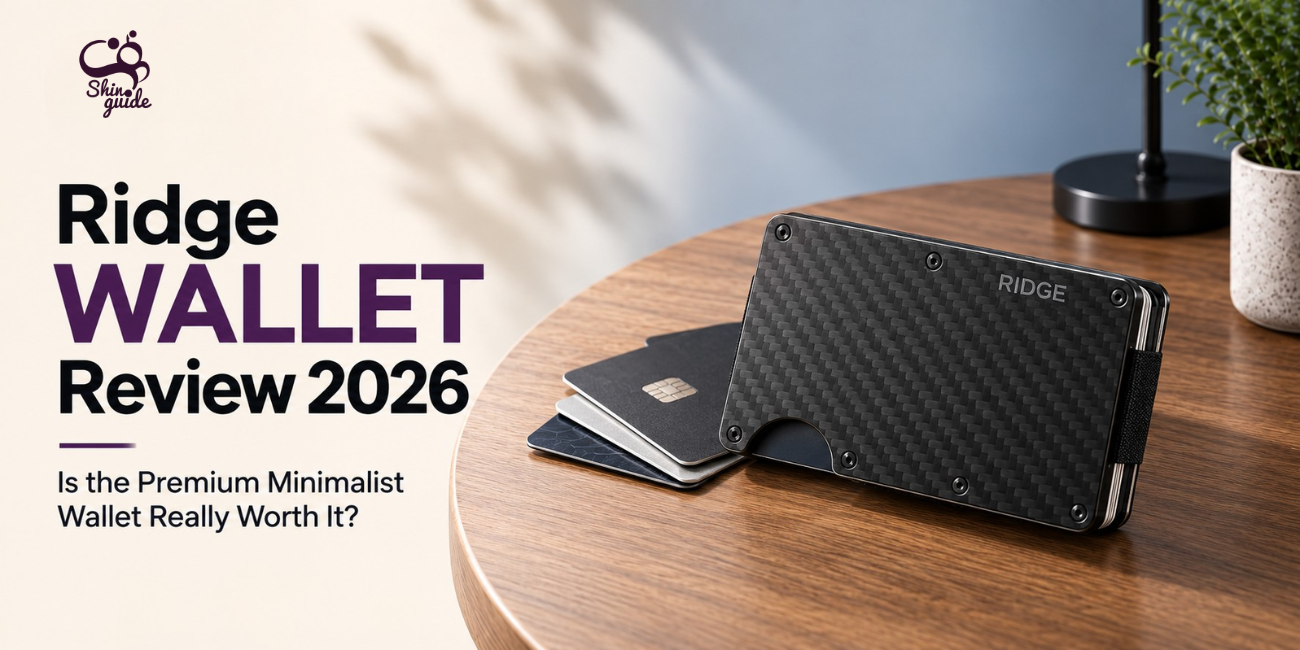
Ridge Wallet Review 2026: Is the Premium Minimalist Wallet Really Worth It?
Quick Verdict
| Category | Verdict |
|---|---|
| Overall Rating | 8.7/10 |
| Best For | Minimalist EDC, durability, front-pocket carry |
| Biggest Strength | Exceptionally compact, rigid construction |
| Biggest Weakness | Expensive and less convenient for frequent card switching |
| Starting Price | Around $95 for core aluminum models |
| Premium Options | Carbon fiber and titanium around $150; specialty finishes can cost more |
| Return Window | 99-day risk-free trial |
| Warranty | Built for Life coverage on qualifying newer purchases |
Ridge Wallet Review 2026
A bulky wallet is one of those everyday annoyances you can tolerate for years without questioning it. Receipts accumulate, expired cards stay buried inside, and eventually you're carrying far more than you actually use. Ridge approaches the problem from the opposite direction. Instead of giving you more compartments, it essentially removes them. The Ridge Wallet uses a compact plate-and-elastic design intended to hold the cards you actually need while keeping the entire package small enough for comfortable front-pocket carry. Ridge describes its wallets as metal, RFID-blocking designs built to carry cards and cash securely. That simplicity is also why Ridge Wallet reviews can be surprisingly divided.
Some owners love the rigid construction and never want to return to leather. Others find manually accessing cards less convenient than a conventional wallet or a pop-up cardholder. And then there is the biggest question: are Ridge Wallets worth it when an aluminum model costs around $95?
This Ridge Wallet review looks beyond the minimalist aesthetic. We'll cover everyday usability, durability, Carbon Fiber 3K, the Ridge MagSafe Wallet, pricing, customer feedback, and the increasingly important Ridge Wallet vs Ekster comparison.
What Is the Ridge Wallet?
Ridge is an everyday-carry brand best known for turning the traditional wallet into a compact cardholder. The core Ridge design uses two rigid outer plates combined with an elastic system. Rather than placing individual cards in separate slots, you carry them together inside the central compartment. The result is significantly different from a leather bifold. Ridge currently offers its wallet platform across numerous materials and finishes. The standard aluminum versions use 6061-T6 aluminum and are listed around $95, while Carbon Fiber 3K and several Grade 2 titanium versions are around $150. Specialty versions can climb substantially higher.
There are also leather-finished versions and separate Ridge Wallet for MagSafe models. The target customer is straightforward: someone who primarily carries cards, perhaps a modest amount of cash, and wants to reduce pocket bulk. It isn't really designed for the person carrying ten receipts, coins, business cards and half a dozen loyalty cards. And that's arguably the point.
Ridge Wallet Key Features
Minimalist Plate Construction
The defining Ridge feature isn't a gimmick. It's the wallet's entire architecture. Traditional wallets get thicker as layers of leather, fabric and card slots stack on top of one another. Ridge eliminates most of those layers by sandwiching cards between two rigid plates. This gives the wallet its unmistakable industrial appearance. It also forces you to reconsider what deserves space in your wallet. For people moving from an overloaded bifold, that can be surprisingly useful. The downside is equally obvious: there aren't individual card slots. If you're expecting the organizational experience of a traditional wallet in a smaller package, Ridge isn't really that.
Premium Material Choices
Material selection is one area where Ridge separates itself from many inexpensive minimalist wallets. The mainstream aluminum Ridge Wallet uses 6061-T6 aluminum. Buyers can step up to Carbon Fiber 3K, forged carbon, Grade 2 titanium and various specialty finishes. Ridge currently lists the core aluminum wallet around $95 and Carbon Fiber 3K around $150. The material choice changes more than appearance.
Aluminum provides the most sensible balance between price, weight and durability for most people. Titanium appeals to buyers who appreciate premium metals and EDC equipment, while carbon fiber provides the distinctive woven appearance many buyers specifically want. None fundamentally changes how Ridge works, however. You're paying for material, finish and ownership experience not a completely different wallet.
RFID-Blocking Construction
Ridge markets its wallets as RFID-blocking. That gives buyers an additional layer of protection for compatible contactless cards, although RFID blocking shouldn't be the sole reason to spend $95–$150 on a wallet. Many inexpensive wallets now offer similar protection. Consider it a useful feature rather than the central value proposition.
Cash Strap and Money Clip Options
Minimalist wallets frequently struggle with cash. Ridge addresses this with external cash-carrying solutions rather than building a bill compartment into the wallet. This keeps the main body compact. The approach works particularly well for someone who primarily pays by card but occasionally carries several folded bills. Heavy cash users will probably still prefer a traditional wallet.
Expandable Card Storage
One clever aspect of the tension-based design is that Ridge doesn't require every owner to carry exactly the same number of cards. The wallet adjusts around your load. In practical terms, this is what makes the design work as an everyday wallet rather than simply a metal card case. Competitor comparisons generally place standard Ridge capacity at up to roughly 12 cards. Still, maximum capacity and ideal capacity aren't necessarily the same thing. The appeal of Ridge is strongest when you embrace minimalism rather than testing how much you can squeeze inside.
Ridge MagSafe Wallet Review
Ridge now offers a dedicated Wallet for MagSafe, bringing the familiar plate design directly onto compatible phones and cases. This isn't simply a standard Ridge with a magnet stuck to the back. Ridge says the design incorporates a custom front plate with arc magnets, a smooth polycarbonate magnet housing intended to avoid scratching the device, plus a strengthening tray and ring system for improving adhesion or accessory compatibility. Pricing is firmly premium. At the time of this review, aluminum Ridge Wallet for MagSafe variants are commonly listed around $150, while the Carbon Fiber 3K MagSafe version is around $175.
The concept makes sense if your phone is already the center of your everyday carry. It means one fewer object in your pocket. However, a Ridge MagSafe Wallet review also has to acknowledge that combining phone and wallet creates a different set of compromises. You need to be comfortable with the added thickness attached to your phone, and magnetic attachment becomes another factor to consider. One recent owner discussion, for example, criticized the perceived magnet strength of a MagSafe model, although individual experiences and phone cases can affect attachment. So we'd view MagSafe as a specialized Ridge rather than an automatic upgrade.
Ridge Carbon Fiber Wallet Review
If you're attracted to Ridge partly because of its design, the Carbon Fiber 3K version is one of the most compelling options. The visible 3K weave immediately gives it a more technical appearance than the standard aluminum wallet. Ridge currently lists Carbon Fiber 3K at about $150, compared with roughly $95 for standard aluminum configurations. That's a $55 premium.
Does it perform $55 better?
Not really. Both versions accomplish the same basic task. The Carbon Fiber 3K model is therefore best viewed as a material and aesthetic upgrade. For an EDC enthusiast who will use the wallet for years, paying extra for the version you genuinely enjoy owning isn't unreasonable. For a value-focused shopper, aluminum is easier to justify.
First Impressions: Very Different From a Leather Wallet
The first thing you'll notice isn't simply how small Ridge looks. It's how solid it feels. A traditional wallet bends with your pocket. Ridge behaves more like a compact piece of hardware. That produces a distinctly premium first impression, particularly with the metal and carbon-fiber variants. Finishes are visually clean and the overall design feels deliberate rather than decorative. Setup is simple: decide which cards deserve to stay, load them into the wallet and choose your preferred cash arrangement. The more important setup happens mentally. You need to stop treating it like a bifold. Ridge works best when you reduce your card stack and establish a routine for where your most-used cards sit. Once you do, the minimalist format makes much more sense.
Real-World Performance
Pocket Comfort
This is where Ridge's concept delivers. Removing the folds, pockets and layered construction of a traditional wallet creates a compact footprint. Front-pocket carry becomes much more practical. The caveat is rigidity. A Ridge Wallet can be thinner than a stuffed leather wallet while simultaneously feeling harder against your leg. Whether that's more comfortable depends on where you carry it.
Card Access
Card access is probably the most polarizing part of the Ridge experience. You push the cards upward and separate the one you need. Once you're familiar with the motion, it becomes fairly natural. But it isn't the fastest card-access system available. If you constantly switch among several cards, a mechanical pop-up wallet such as an Ekster can feel more convenient because its cards fan outward. Ekster's comparison materials describe Ridge as using a manual thumb-push/tension system, whereas its own cardholders use mechanical pop-up access. That's a genuine usability distinction not merely marketing.
Durability
Rigid materials are one of Ridge's biggest selling points. Metal and carbon fiber don't stretch or soften like conventional leather, and the wallet is designed to be serviced rather than treated as disposable. However, durable does not mean indestructible. Cosmetic wear can occur, and elastic or small hardware can eventually require attention. Recent community feedback includes both long-term owners reporting years of trouble-free use and others complaining about screws or elastic components. Ridge's warranty partly offsets that concern, which we'll discuss below.
Everyday Practicality
For a card-first user, Ridge works remarkably well. For a receipt-and-cash-first user, it doesn't. That distinction matters more than the material you select. The wallet succeeds because it deliberately refuses to accommodate everything a conventional wallet does. Buy it expecting a better minimalist card wallet, and the experience makes sense. Buy it expecting a tiny bifold, and it may feel restrictive.
Ridge Wallet Pricing: Is It Good Value?
Here's where this review becomes more complicated. Current direct pricing places many standard aluminum Ridge Wallets at about $95. Carbon Fiber 3K, forged carbon and several titanium configurations sit around $150, while certain specialty materials and finishes can reach roughly $195–$295. Prices and promotions can change. That's premium-wallet money. There are numerous minimalist metal wallets available for substantially less.
So what are you paying for?
Partly materials and manufacturing. Partly design consistency and the Ridge ecosystem. Partly warranty support. And undeniably, partly the brand. Ridge currently advertises a 99-day risk-free trial on its wallet collection. More significantly, qualifying Ridge Wallets purchased on or after October 14, 2025 from Ridge's official sites, official Amazon listings or authorized retailers fall under its Built for Life Warranty. Ridge says this can cover manufacturing defects as well as normal wear, accidental damage, loss and theft, subject to the program's terms and processing fees for full replacements. That's a meaningful part of the value proposition, although buyers should read the current warranty terms rather than assuming every future replacement is completely free.
Is the premium justified?
For someone who will carry it every day for years, potentially yes. For someone who simply wants to experiment with minimalist wallets, probably not. Start with the standard aluminum version unless a premium material is specifically important to you.
Ridge Wallet Pros and Cons
| Pros | Cons |
|---|---|
| Compact minimalist construction | Expensive compared with generic alternatives |
| Durable aluminum, titanium and carbon-fiber options | Card access requires adjustment |
| RFID-blocking design | Not ideal for lots of cash or receipts |
| Excellent material and color selection | Hard structure won't suit everyone |
| 99-day trial advertised | Premium materials raise price quickly |
| Built for Life warranty for qualifying newer wallets | Cosmetic wear can still happen |
| MagSafe option available | MagSafe versions are particularly expensive |
| Replaceable/serviceable components | Pop-up competitors offer quicker card access |
Who Should Buy a Ridge Wallet?
Ridge makes the most sense for someone who already knows they want a minimalist wallet. If you carry a driver's license, several payment cards and a little cash, its design fits that lifestyle extremely well. It's also appealing to EDC enthusiasts. There is something satisfying about a wallet made from the same types of materials associated with premium tools, watches and technical equipment. The Carbon Fiber 3K and titanium models particularly target that buyer. And if you regularly destroy conventional leather wallets, Ridge's serviceable construction and warranty program provide another reason to consider the higher upfront cost.
| Buyer | Recommendation |
|---|---|
| Minimalist/card-first user | Highly recommended |
| Front-pocket carrier | Recommended |
| EDC enthusiast | Highly recommended |
| Carbon-fiber fan | Recommended |
| Heavy cash user | Consider alternatives |
| Budget shopper | Look elsewhere first |
| iPhone/MagSafe minimalist | Consider Ridge MagSafe |
Who Should Avoid the Ridge Wallet?
Skip Ridge if you genuinely enjoy the organization of a traditional bifold. There's nothing wrong with needing multiple card slots, a dedicated bill compartment and space for receipts. Ridge simply isn't designed around that behavior. Frequent card switchers should also think carefully. The tension system is clever, but manually separating cards isn't as quick as a pop-up mechanism. Finally, price-sensitive buyers should recognize that much of Ridge's value lies in ownership experience, materials, design and warranty—not just functionality. A $30 metal cardholder can hold cards too. Ridge has to justify its price through the complete package.
Customer Feedback: What Do Ridge Wallet Reviews Say?
Customer sentiment is broadly positive, but not universally so. Trustpilot currently displays a 4.4/5 rating across roughly 2,481 reviews for the Ridge Wallet domain, with recent reviewers frequently praising product quality, warranty handling and customer service. Long-term owner discussions also include people reporting years of trouble-free use. One 2026 owner described receiving a replacement after a warranty issue on a wallet several years old. But there is another side worth taking seriously. Recent Reddit discussions contain complaints involving slow customer-service responses, screws loosening, elastic/cash-strap problems and frustration with the manual card-access system. Other users in some of those same discussions report positive support experiences, making the service picture noticeably mixed.
That balance is important. We wouldn't interpret isolated complaints as evidence that every Ridge Wallet will fail. Nor would we treat a strong aggregate rating as proof that every customer receives flawless service. The recurring themes are clearer: people who love Ridge tend to value compactness, materials and longevity. Critics tend to focus on price, card access, hardware/elastic wear or support delays.
Ridge Wallet vs Ekster
This is probably the most relevant premium-wallet comparison. Both brands aim to reduce wallet bulk, but they approach the problem differently.
| Feature | Ridge Wallet | Ekster Cardholder Pro |
|---|---|---|
| Core concept | Rigid plate wallet | Mechanical pop-up cardholder |
| Starting price* | Around $95 | Around $119 |
| Card access | Manual push/separate | Push-button card fan |
| Capacity | Roughly up to 12 cards | Up to around 14 depending configuration |
| RFID protection | Yes | Yes |
| Material options | Extensive | Aluminum-focused |
| Cash | Strap/clip options | Modular solutions |
| Tracking | Optional Ridge Tracker Card | Optional tracker ecosystem |
| Best for | Rugged minimalism | Fast card access |
Pricing changes; check current listings before purchasing. Ridge's current core wallet listing starts around $95, while Ekster currently lists its Cardholder Pro from around $119 in its own comparison guide.
Which one is better?
Choose Ridge if simplicity and ruggedness matter most. Choose Ekster if you repeatedly access different cards and value the pop-up mechanism. Ridge feels more like a piece of minimalist EDC equipment. Ekster feels more like a modern card-access system. Neither approach is objectively superior.
Is Ridge Wallet Legit?
Yes. Ridge is an established consumer brand selling through its own storefront and authorized channels, with published return and warranty programs. The more useful question isn't “is Ridge Wallet legit?” It's whether Ridge's premium is worthwhile for your wallet habits. The product is legitimate. The value judgment is subjective.
FAQs
Are Ridge Wallets worth it?
They can be. Ridge makes the most sense for buyers who specifically value minimalist carry, rigid premium materials and long-term ownership. Budget shoppers can find functional alternatives for substantially less.
How much does a Ridge Wallet cost?
Core aluminum Ridge Wallets are currently listed around $95, while Carbon Fiber 3K and several titanium models are around $150. Specialty configurations can cost considerably more.
Is Ridge Wallet legit?
Yes. Ridge sells directly through its official storefront and publishes formal return and warranty policies.
Does the Ridge Wallet block RFID?
Yes. Ridge describes its wallet line as RFID-blocking.
How many cards does a Ridge Wallet hold?
The design is intended for a compact stack of cards, with competitor specifications commonly putting capacity at up to about 12 cards. Your ideal everyday load may be smaller if maximum slimness is the goal.
Is the Ridge Carbon Fiber Wallet worth the extra money?
It is worthwhile primarily for buyers who value its lighter, technical material and 3K weave appearance. Functionally, the standard aluminum model provides much of the same core experience for less.
Is the Ridge MagSafe Wallet worth it?
It makes the most sense if you intentionally want to combine your phone and wallet. Aluminum MagSafe versions are currently around $150, while Carbon Fiber 3K is around $175, so the convenience carries a significant premium.
Ridge Wallet vs Ekster: which has easier card access?
Ekster's pop-up mechanism is faster for browsing multiple cards. Ridge uses a manual push-and-separate approach. Ridge may appeal more to buyers prioritizing simplicity and fewer moving parts.
Does Ridge have a lifetime warranty?
Qualifying Ridge Wallets purchased on or after October 14, 2025 are covered by Ridge's Built for Life program, while older qualifying wallets fall under its Standard Lifetime Warranty. Exact coverage and replacement fees vary, so buyers should check current terms.
Does Ridge offer returns?
Ridge currently advertises a 99-day risk-free trial on its wallet collection.
Does a Ridge Wallet scratch cards?
The cards are stored under tension rather than in conventional soft leather slots. Normal card wear can occur with any wallet, but reports vary considerably depending on use and card finishes. If pristine cards are a major priority, a softer wallet may be preferable.
Which Ridge Wallet should I buy?
For most people, we'd start with the standard 6061-T6 aluminum Ridge Wallet. It delivers the core Ridge experience without paying the substantial premium for carbon fiber, titanium or specialty finishes.
Final Verdict: Is the Ridge Wallet Worth It in 2026?
After looking at the current lineup, pricing, construction, warranty and owner feedback, our Ridge Wallet review lands in positive but not unconditional territory. Ridge gets the fundamentals right. The wallet is genuinely compact. Its rigid construction differentiates it from ordinary bifolds. The range of aluminum, titanium, carbon fiber and specialty finishes is extensive, and Ridge's current 99-day trial and warranty program strengthen the ownership proposition. The standard aluminum model is the sweet spot. At around $95, it's still expensive, but you get the recognizable Ridge design without pushing into the $150+ territory occupied by Carbon Fiber 3K and premium variants.
Our biggest reservation isn't durability or legitimacy. It's usability. Ridge requires you to embrace its minimalist philosophy. Card access isn't as effortless as a mechanical pop-up wallet, and carrying substantial cash, receipts or miscellaneous cards defeats the purpose. If you want a traditional wallet just smaller look elsewhere. If you want to fundamentally simplify what you carry, Ridge remains one of the strongest premium options.